White House Unveils 97-Step Plan to Explain Things Simply, Clarifies That It Will Take Eleven Pages to Define the Word 'Clear'

White House Unveils 97-Step Plan to Explain Things Simply, Clarifies That It Will Take Eleven Pages to Define the Word 'Clear'
The federal government would like to speak with you more clearly. It has written this down.
 Photo: White House, via storage.googleapis.com
The document in question is the Federal Plain Language and Accessibility Framework for Strategic Public Communications Optimization, or FPLAFSPCO, a title that the document itself acknowledges, in footnote 14, "may benefit from simplification in future iterations." It runs to 340 pages, contains 97 numbered action items, references 23 separate interagency working groups, and includes a glossary that defines the word "clear" across eleven pages, subdivided by context, audience type, and what the document calls "communicative intent register."
It was released last Monday to help the government communicate more clearly.
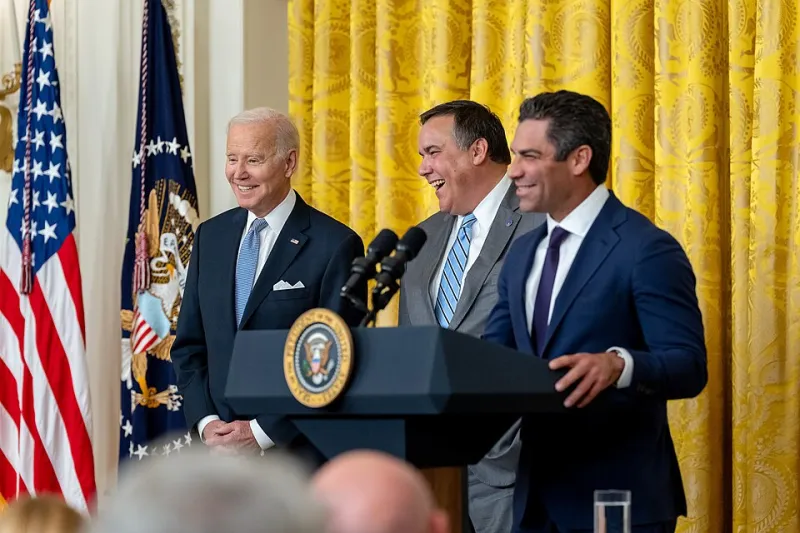
"This framework represents a historic commitment to meeting Americans where they are," said Deputy Communications Director for Strategic Messaging Alignment Theresa Baumgartner-Cole at a press briefing that ran 47 minutes over its scheduled time. "For too long, federal communications have been inaccessible, jargon-heavy, and disconnected from the lived experience of everyday citizens. That ends now."
The briefing was conducted using a 64-slide presentation. Eleven of the slides contained bullet points with more than eight items. Four slides were in a font size that reporters in the back row described as "optimistic."
A Document About Simplicity That Is Not Simple
The framework opens with an executive summary, which is itself six pages long. The executive summary contains a note directing readers to Appendix C for "contextual background necessary to interpret the summary's core assertions." Appendix C is 28 pages and references a separate technical addendum that was not included in the public release but is, according to footnote 7, "available upon request pending clearance review."
The framework's central thesis — that government should communicate more plainly — is expressed as follows in Section 1.2:
"The optimization of public-facing communicative outputs requires a foundational recalibration of message architecture to ensure that informational accessibility metrics align with audience comprehension baselines across diverse demographic cohorts, with particular attention to readability indices, cognitive load parameters, and the iterative refinement of plain-language compliance benchmarks as defined in subsection 4.7 of this document and cross-referenced in Appendix F."
Subsection 4.7 defines plain language as "language that is plain."
Appendix F was not included in the public release.
The 97 Action Items, Summarized
The framework's operational core is a 97-point action plan organized across five phases: Assessment, Alignment, Architecture, Activation, and what Phase Five calls "Actualization," which the document describes as "the phase in which plain language is used."
Phases One through Four are each estimated to take between eight and fourteen months. Phase Five does not have an estimated timeline. A footnote explains that "actualization timelines are subject to interagency coordination requirements and stakeholder validation protocols that cannot be predetermined at the framework stage."
Among the 97 action items:
- Item 12: Establish a Plain Language Steering Committee to oversee the work of the Plain Language Working Group.
- Item 13: Establish a Plain Language Working Group to support the Plain Language Steering Committee.
- Item 31: Commission an external audit of current agency communications to identify jargon.
- Item 32: Commission an internal review of the external audit to validate jargon identification methodology.
- Item 58: Develop a Plain Language Style Guide.
- Item 59: Develop a Style Guide for the Plain Language Style Guide.
- Item 97: Evaluate the effectiveness of this framework and determine whether a new framework is needed.
"We wanted to be comprehensive," said Baumgartner-Cole.
The Glossary, Which Is Its Own Achievement
Perhaps the framework's most ambitious section is its glossary, which runs to 67 pages and defines 214 terms. These include:
Clarity: The property of a communication that enables comprehension. See also: Comprehensibility, Legibility, Transparency (communicative), Transparency (structural), and Transparency (aspirational).
Simple: Characterized by the absence of unnecessary complexity. Note: "unnecessary" is defined in subsection 9.4. Note to Note: subsection 9.4 was revised after this glossary entry was drafted. See updated definition in Addendum B.
The Public: For the purposes of this framework, "the public" refers to individuals who are not employees of the federal government, contractors operating under federal agreement, or members of interagency working groups. See Appendix H for exceptions.
Appendix H was not included in the public release.
The glossary also defines "jargon" as "terminology that is unnecessarily specialized for its intended audience," a definition that appears in a document containing the phrase "cognitive load parameters" approximately 34 times.
Experts Weigh In, Using Words Longer Than They Should
"What you're seeing here is a classic instance of institutional isomorphism," said Dr. Leonard Pryce, a communications scholar at Johns Hopkins who was quoted in the framework's bibliography despite not being aware he had been quoted. "The organization attempting to change its behavior is doing so using the same behavioral patterns it is attempting to change. It's not malicious. It's just what bureaucracies do."
 Photo: Johns Hopkins, via abound.college
When asked to explain this more simply, Dr. Pryce said: "They wrote a complicated document about not being complicated."
The White House Office of Strategic Public Communications disputed this characterization. In a statement, the office noted that the framework had been reviewed by three plain-language experts, two accessibility consultants, and a focus group of eight members of the public who were, the statement noted, "broadly supportive of the initiative's goals."
The statement was 600 words long. It did not include a summary.
The Plain-Language Summary, Which Is Coming
In recognition that the 340-page framework may itself present accessibility challenges, the Office of Strategic Public Communications announced that a plain-language summary of the document is currently in development.
The summary is expected to be released in twelve to eighteen months, pending review by the Plain Language Steering Committee, validation by the Plain Language Working Group, and sign-off from what the framework describes as the "Executive Clarity Assurance Function," a body whose membership and meeting schedule are not specified in the public release.
A one-page overview of the plain-language summary — described in the framework as a "Tier 1 Accessibility Distillation" — is also planned, and is expected to follow the summary by approximately six months.
"We want every American to feel that their government is speaking to them," said Baumgartner-Cole, at the close of last Monday's briefing. "That's the whole point of this."
She was then asked a question by a reporter from a regional newspaper in Iowa. The question was about crop insurance.
Baumgartner-Cole referred the reporter to the USDA's public communications portal, which, she noted, was currently being updated to comply with the new framework.
The portal is expected to relaunch in Phase Four.
Phase Four begins after Phase Three.
Phase Three has not started.