After Years Of Careful Deliberation, Congress Agrees To Carefully Deliberate On Whether To Carefully Deliberate
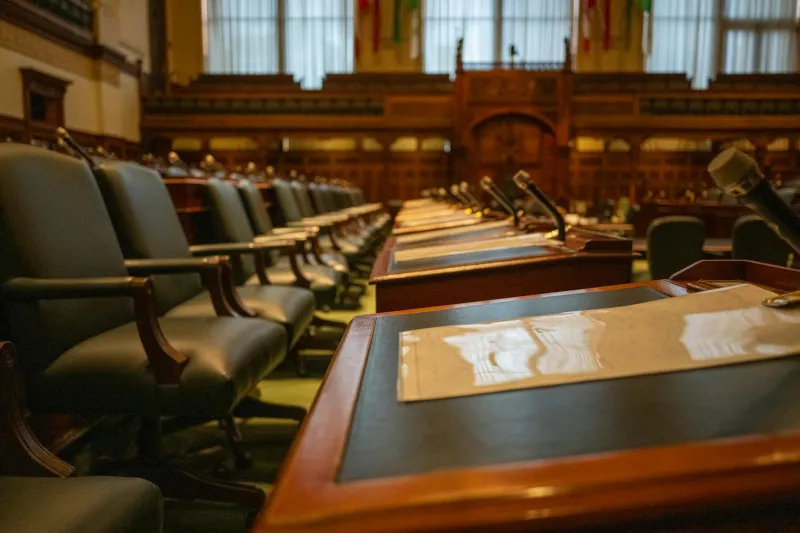
After Years Of Careful Deliberation, Congress Agrees To Carefully Deliberate On Whether To Carefully Deliberate
WASHINGTON D.C. — In what senior congressional aides are calling "a genuine watershed moment for the process of processing processes," the United States Congress announced Thursday the formation of the Bipartisan Preliminary Working Group on the Feasibility of Establishing a Subcommittee to Evaluate the Structural Prerequisites for a Potential Select Committee on Emerging National Priorities.
It is, by most measures, the most ambitious thing Congress has done in eleven months.
"We heard the American people," said Senator Dale Whitmore (R-OH), one of the working group's seventeen co-chairs, reading carefully from a prepared statement while appearing not entirely certain what was on it. "They said: do something. And today, we are doing something. We are doing the thing that leads to the thing that will eventually, God willing, result in the consideration of doing another thing."
The senator paused for applause. There was a moderate amount.
The Problem, As Best As Anyone Can Recall
The working group was convened in response to what congressional leadership described in a press release as "a range of pressing national concerns," a phrase that appeared seven times in the document and was never elaborated upon. When asked to specify which concerns, a spokesperson for the House Majority Leader's office referred reporters to a second press release, which linked back to the first.
Sources familiar with the matter — which, after three weeks of background briefings, includes most of official Washington — suggest the original impetus may have been a constituent letter, a cable news segment, or possibly a bet. Accounts differ. The record, such as it is, has been referred to the Subcommittee on Records, which has not met since 2019.
What is not in dispute is the working group's mandate: to spend the next eighteen months producing a comprehensive report on whether the legislative branch possesses the institutional architecture necessary to support a formal committee structure capable of addressing whatever the original problem turns out to be.
"It's quite elegant, really," said Dr. Frances Oduya, a professor of legislative studies at Georgetown University who has spent thirty years watching Congress do this. "You've essentially created a buffer zone between the problem and the response, and then put a second buffer zone around the first one. It's like legislative bubble wrap."
She did not sound particularly enthusiastic.
The Working Group: A Portrait
The Bipartisan Preliminary Working Group currently comprises seventeen co-chairs, four "observer members" who attend but do not vote, two senators who joined under the impression it was a different working group, and one congressman who has not yet been informed he is on it.
Its first meeting, held in a Senate conference room last Tuesday, lasted three hours and forty minutes, of which approximately twenty-two minutes were devoted to the working group's actual mandate. The remaining time was allocated as follows: forty minutes on the question of whether the meeting minutes should be public or classified; one hour on catering; thirty-eight minutes on whether the group needed its own logo; and the final forty minutes on a spirited debate over what to call the subgroup that would be tasked with drafting the working group's internal operating procedures.
That subgroup — the Provisional Organizational Framework Subpanel, or POFS — will meet for the first time in March, pending room availability.
"We are being very deliberate," said Senator Whitmore, reached again by phone the following day. "Deliberateness is our core competency."
When asked what the group's second core competency was, he said he would have to check with his team.
A Rich And Storied Tradition
For those unfamiliar with the rhythms of Capitol Hill, the formation of a working group to study whether to form a committee may seem unusual. For those who cover Congress professionally, it is something close to comfort food.
The Congressional Research Service, in a 2021 report that was itself the product of a two-year study into congressional study habits, identified 847 active working groups, task forces, and exploratory panels operating within the legislative branch — of which 214 had produced no public output, 309 had produced reports recommending further study, and 41 had, at some point, recommended their own dissolution without anyone acting on the recommendation.
"Congress doesn't create committees to solve problems," explained Dr. Oduya. "It creates committees to demonstrate awareness of problems. There's an important distinction. One requires legislation. The other requires a press release and a Tuesday afternoon."
She noted, with the resignation of someone who has given this lecture many times, that the system is not entirely without logic. Working groups do occasionally produce useful findings. Task forces have, on record, led to actual legislation. The process, for all its baroque absurdity, sometimes works.
"Sometimes," she said. "In the same way that a stopped clock is right twice a day, except the clock also has seventeen co-chairs and can't agree on what time zone it's in."
The Report
Eighteen months later, the Bipartisan Preliminary Working Group on the Feasibility of Establishing a Subcommittee to Evaluate the Structural Prerequisites for a Potential Select Committee on Emerging National Priorities released its final report.
The document ran to 340 pages, including appendices. Its executive summary ran to fourteen pages. Its summary of the executive summary ran to four pages and included a chart.
Its central finding: that conditions appeared "broadly favorable" for the formation of a select committee, subject to further review by a newly proposed body — the Transitional Advisory Panel on Committee Readiness — which would require an initial operating budget of $2.3 million and was expected to report back within two years.
Senator Whitmore, at the report's unveiling, called it "a landmark achievement in the history of American governance."
Three journalists in the room wrote that down. The rest had already left to cover a different working group.
The Orderly Chaos will continue monitoring the Transitional Advisory Panel on Committee Readiness. We expect to have more to report by 2027, assuming the panel has met by then.