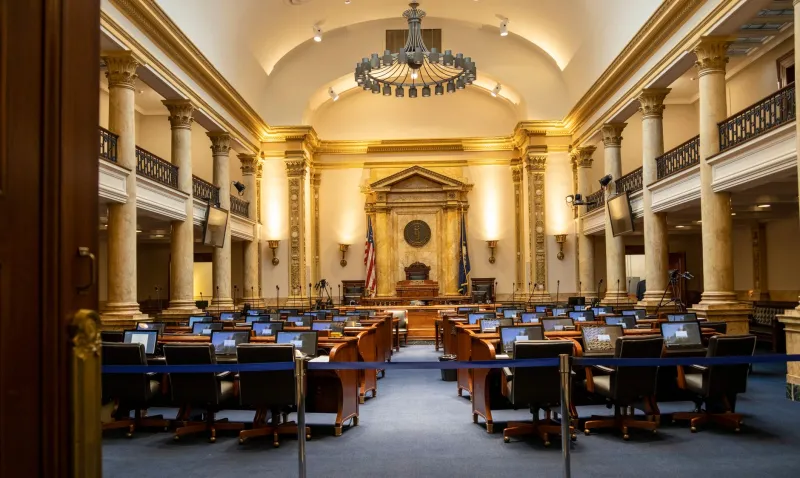
Campaign Consultants Announce, With Great Confidence, That 2026 Is Categorically Unlike Every Other Year They Have Said This
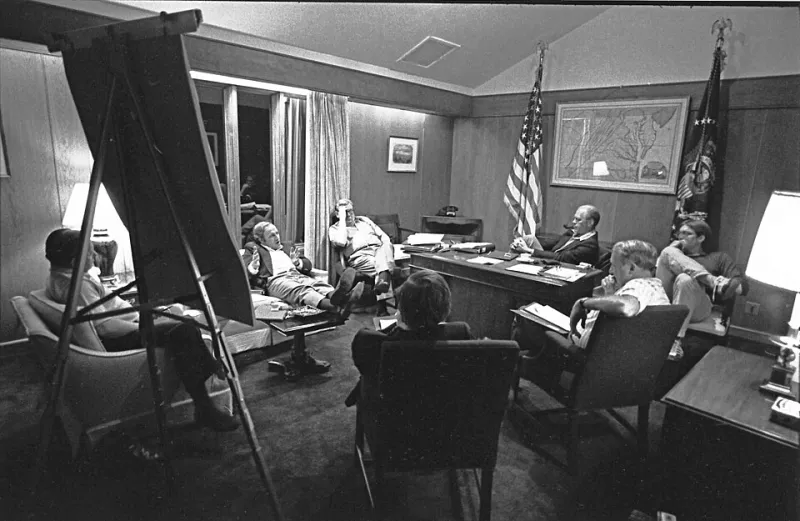
Photo: David Hume Kennerly, Public domain, via Wikimedia Commons
WASHINGTON — In a development that political observers described as "right on schedule," the nation's leading campaign consultants gathered at a Georgetown hotel this week to formally declare that the 2026 midterm election cycle represents a genuinely unprecedented opportunity to engage American voters in a serious, nuanced, fact-based dialogue about the issues that matter most.
This declaration was made with complete sincerity. It was also, according to archived transcripts, press releases, and one partially legible fax recovered from a K Street storage unit, made in 2022, 2018, 2014, 2010, and, in slightly different formatting, 1994.
Retainer fees, sources confirm, have already been collected.
The Electorate Is Finally Ready (Again)
The panel, convened under the auspices of the Strategic Communications and Voter Engagement Leadership Forum — a body that exists primarily to convene panels — featured six consultants whose combined hourly billing rate exceeds the annual salary of the average American schoolteacher by a margin that none of them appeared to find awkward.
"What we're seeing in the data," said Marcus Delray, a senior partner at a firm whose client list is described on its website as "transformative campaigns across the political spectrum," meaning they have worked for candidates on both sides who subsequently lost, "is a voter who is tired of noise and hungry for substance. 2026 is the year that changes everything."
Delray made a nearly identical statement in November 2021, predicting that 2022 would be the year that changed everything. When this was raised during a brief Q&A, he described 2022 as "a transitional cycle that laid the groundwork for the maturation we're now seeing."
This answer satisfied approximately no one but was delivered with sufficient confidence that follow-up questions were not pursued.
The Historical Record, Lightly Reviewed
The Orderly Chaos obtained a selection of documents spanning three decades of consultant predictions about voter readiness for nuanced political discourse. The findings were, in the technical sense, consistent.
A 1994 memo from a Democratic strategy firm — recovered from the aforementioned storage unit alongside a broken fax machine and what appeared to be a Newt Gingrich dartboard — declared that the American electorate was "positioned, perhaps for the first time, to reward candidates who lead with policy depth rather than political theater." The 1994 midterms subsequently delivered the largest Republican House majority in forty years, a result the memo's author later described as "a nuance that takes time to fully appreciate."
A 2002 PowerPoint presentation, formatted in a font that no longer exists, predicted that post-9/11 civic seriousness would produce a new era of policy-driven campaigning. A 2006 strategy brief forecast a "substantive voter renaissance." A 2010 document described the Tea Party wave as, and this is a direct quotation, "an expression of sophisticated democratic engagement that campaigns with the right message can harness productively."
"Each cycle builds on the last," explained Priya Vashankar, a consultant who specializes in what her firm's website calls "narrative infrastructure," and who has been described by three separate clients as having billed them for "strategic alignment sessions" that appeared, on reflection, to be lunches. "The electorate is on a journey. 2026 is a significant waypoint on that journey."
When asked where the journey was going, she described it as "a space of ongoing discovery."
The Science of Saying This With a Straight Face
What is perhaps most impressive about the consultant class's perennial optimism about voter sophistication is not the prediction itself but the delivery mechanism. These are not naive people. They have watched American elections for decades. They have seen what actually moves voters. They have, in many cases, been directly responsible for the exact kind of political content they are now declaring obsolete.
And yet, every two years, with the reliability of a dental cleaning reminder, they announce that this time is different.
Experts in political communication say this is less paradox than business model.
"The prediction that voters are ready for nuance serves a very specific function," said Dr. Carla Osei, a political scientist at George Washington University who studies campaign industry behavior and whose work is cited frequently in consultant pitches and almost never in consultant practice. "It gives candidates permission to hire expensive people to craft sophisticated messaging, which is a more lucrative engagement than 'run the same ads as last time.' The prediction isn't really about voters. It's about the pitch deck."
 Photo: George Washington University, via d33wubrfki0l68.cloudfront.net
The consultants, when presented with this analysis, described it as "reductive" and "missing the texture of what we're actually seeing on the ground," before returning to a buffet that cost, per the hotel's published catering menu, $85 per person.
What the Data Actually Shows
Polling data from the past three decades does not, in any obvious way, support the thesis that American voters are trending toward appetite for policy complexity. Attention spans for political content have shortened. Negative advertising remains the most reliable driver of turnout. The single most effective piece of political communication in the modern era is, by most measures, a meme.
The consultants are aware of this data. Several of them have produced it.
"Look, the data shows what the data shows," said one panelist, who asked not to be named because they had a client call after the forum. "But data describes where we've been. Strategy is about where we're going. And where we're going, in 2026, is a place where substance wins."
They paused.
"Probably," they added. "With the right framing."
The forum concluded with a cocktail hour, a group photograph, and the distribution of a white paper titled The Nuance Dividend: Why 2026 Is the Inflection Point American Democracy Has Been Waiting For, which retails for $299 and is, sources confirm, already in its second printing.